
Description
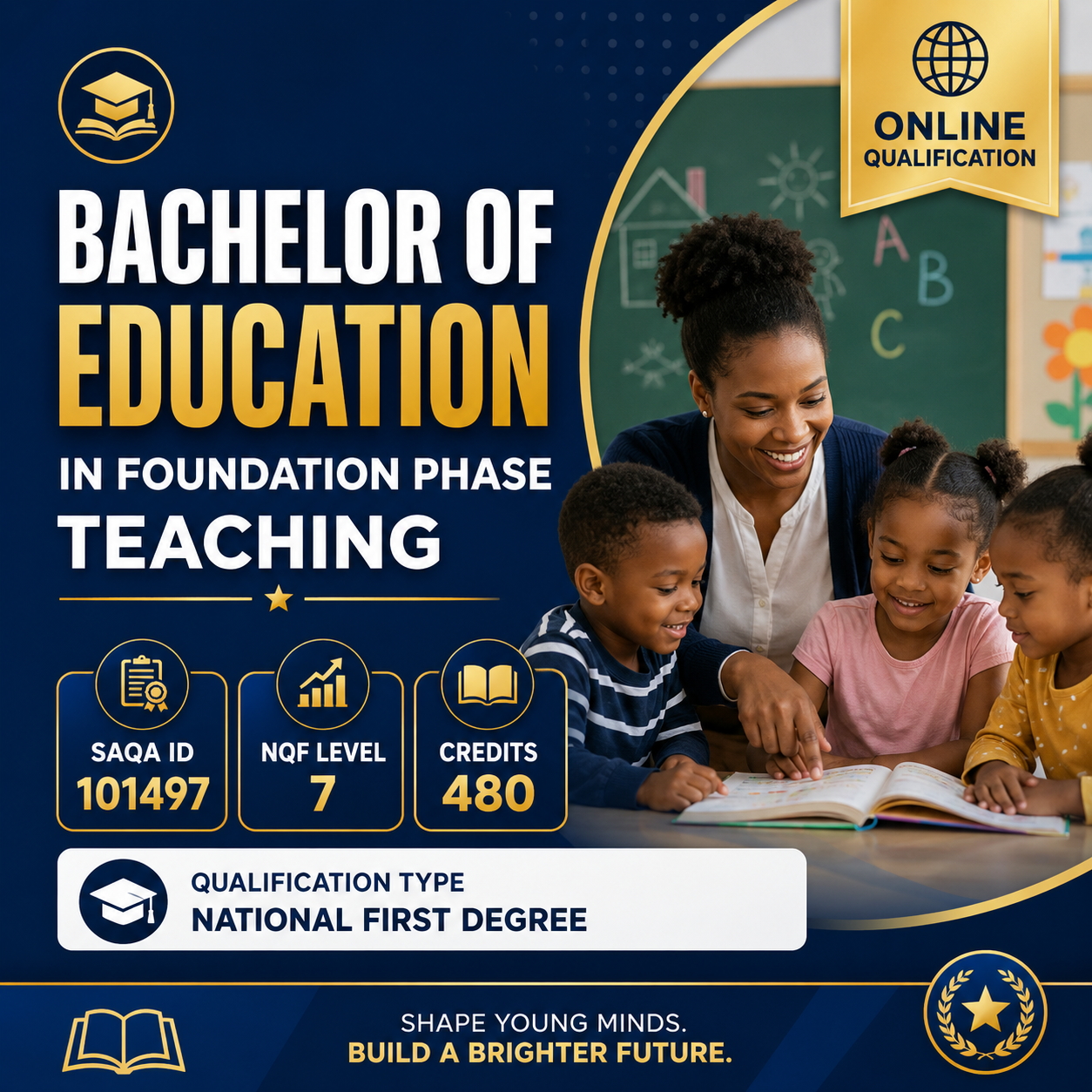
Bachelor of Education in Foundation Phase Teaching — SAQA ID 101497
The Bachelor of Education in Foundation Phase Teaching is a professional undergraduate teaching qualification designed to prepare competent, reflective and ethically responsible teachers for the Foundation Phase, Grades R to 3. The qualification is registered at NQF Level 7 and carries a minimum of 480 credits. It falls within the field of Education, Training and Development and the subfield of Schooling.
The programme is designed to provide future teachers with a strong combination of subject knowledge, pedagogical knowledge, practical teaching competence, educational theory and professional practice. Its central purpose is to equip graduates with the specialised competencies needed to teach young learners effectively during the crucial early years of formal schooling. Particular emphasis is placed on the development of strong foundations in Languages, Mathematics and Life Skills, together with the ability to integrate these learning areas meaningfully within the Foundation Phase classroom.
Throughout the programme, students develop a thorough understanding of how children learn and develop, how learning environments should be structured, and how teaching strategies can be adapted to meet the diverse needs of learners. The qualification introduces learners to theories of teaching and learning, educational psychology, curriculum design, classroom management, assessment, inclusion, learner support, professional ethics and the broader South African education system.
A major focus of the qualification is the ability to interpret and implement the National Curriculum Statement and Curriculum and Assessment Policy Statement (CAPS) within the Foundation Phase. Students learn how to design lessons and learning programmes, sequence teaching and assessment activities, select appropriate teaching and learning resources, and use suitable methodologies for teaching young learners in Grades R to 3.
The programme also develops specialised teaching competence in literacy and language development. Students learn how language supports learning, how to facilitate emergent literacy and language development, and how to adapt communication and teaching approaches for learners with different linguistic backgrounds and learning needs. The qualification includes learning in English, Afrikaans, an African conversational language, and English First Additional Language within its registered curriculum structure.
In Mathematics, students develop both the subject knowledge and teaching methodologies required to introduce young learners to early numeracy, mathematical reasoning, problem-solving and mathematical concepts appropriate to the Foundation Phase. The programme includes progressive Mathematics modules together with specialised methodology for Grade R and Grades 1 to 3.
The Life Skills component introduces students to broader areas that support holistic childhood development. These include elements of health education, social studies, natural science and technology, art, music, movement and drama. This enables future teachers to create stimulating, developmentally appropriate and integrated learning experiences for young children.
A key strength of the qualification is its substantial emphasis on Teaching Practice and Work-Integrated Learning. Students progressively apply educational theory within authentic school and classroom environments through multiple practice-teaching components. These experiences are intended to help student teachers plan and present lessons, facilitate learning, manage classrooms, work with learners from diverse backgrounds, use appropriate resources, assess learner progress and develop professional confidence.
The programme also prepares students to work effectively in inclusive and diverse South African classrooms. Graduates are expected to recognise common barriers to learning, understand the social and developmental factors affecting children, identify appropriate support and intervention strategies, and create classroom environments that respect differences in culture, language, gender, disability, beliefs and social background.
Assessment is another important component of the programme. Students develop an understanding of the purpose and role of assessment in teaching and learning and learn how to design and implement appropriate assessment activities. Assessment across the qualification may include case studies, problem-solving assignments, projects, portfolios, written and oral examinations, simulated teaching and in-school teaching practice. Integrated assessment is intended to determine whether the student can combine theoretical understanding, practical teaching ability and reflective professional judgement.
The qualification further develops research and academic inquiry skills. Students engage with research methodology and undertake a research project, enabling them to identify educational issues, access and evaluate information, critically analyse professional and academic literature, and investigate challenges within teaching and learning. This research foundation also supports progression into postgraduate study.
Professionalism is embedded throughout the programme. Students are expected to develop a strong professional work ethic, responsible conduct, accountability, respect for learners and colleagues, and an understanding of professional ethics and educational governance. They are prepared to communicate professionally with parents, communities, colleagues and other education stakeholders and to contribute responsibly to the broader school environment.
Key learning areas
The registered curriculum includes learning in areas such as Foundation Phase pedagogy, Mathematics, Languages, Life Skills, educational psychology, education theory, curriculum studies, classroom practice, teaching methodology, academic writing, end-user computing, natural science and technology, health and HIV/AIDS education, art, music, movement and drama, professional ethics, research methodology and extensive teaching practice.
What learners should be able to do on completion
Graduates should be able to:
- demonstrate sound subject knowledge in Languages, Mathematics and Life Skills;
- apply appropriate Foundation Phase teaching methodologies;
- design and facilitate effective learning experiences for Grades R to 3;
- interpret and implement CAPS and other applicable curriculum requirements;
- design and apply appropriate learner assessment;
- manage classrooms effectively and create environments conducive to learning;
- support diverse learners and respond to barriers to learning;
- use teaching resources appropriately;
- demonstrate professional ethics, accountability and sound educational judgement;
- conduct basic educational research;
- critically engage with issues affecting South African education; and
- integrate educational theory with professional classroom practice.
Entry requirements
The registered qualification provides for admission through either a Senior Certificate with endorsement or a National Senior Certificate granting access to Bachelor’s Degree studies. Recognition of Prior Learning may also be applied in accordance with institutional and regulatory requirements.
Career opportunities
Successful graduates are primarily prepared for professional teaching roles as Foundation Phase teachers for Grades R to 3, subject to the applicable professional registration requirements. The qualification can also provide a foundation for careers and further development in areas such as Foundation Phase curriculum support, learner support, educational programme development and education-related professional services.
It also provides opportunities for further study. The registered articulation routes include an Advanced Diploma in Education at NQF Level 7 and progression to qualifications such as a Bachelor of Education Honours or Postgraduate Diploma in Education at NQF Level 8.
Qualification details
Qualification: Bachelor of Education in Foundation Phase Teaching
SAQA ID: 101497
NQF Level: 7
Minimum Credits: 480
Qualification Type: National First Degree
Field: Education, Training and Development
Subfield: Schooling
Quality Assurance: Council on Higher Education
NQF Sub-Framework: Higher Education Qualifications Sub-Framework

Reviews
There are no reviews yet.